
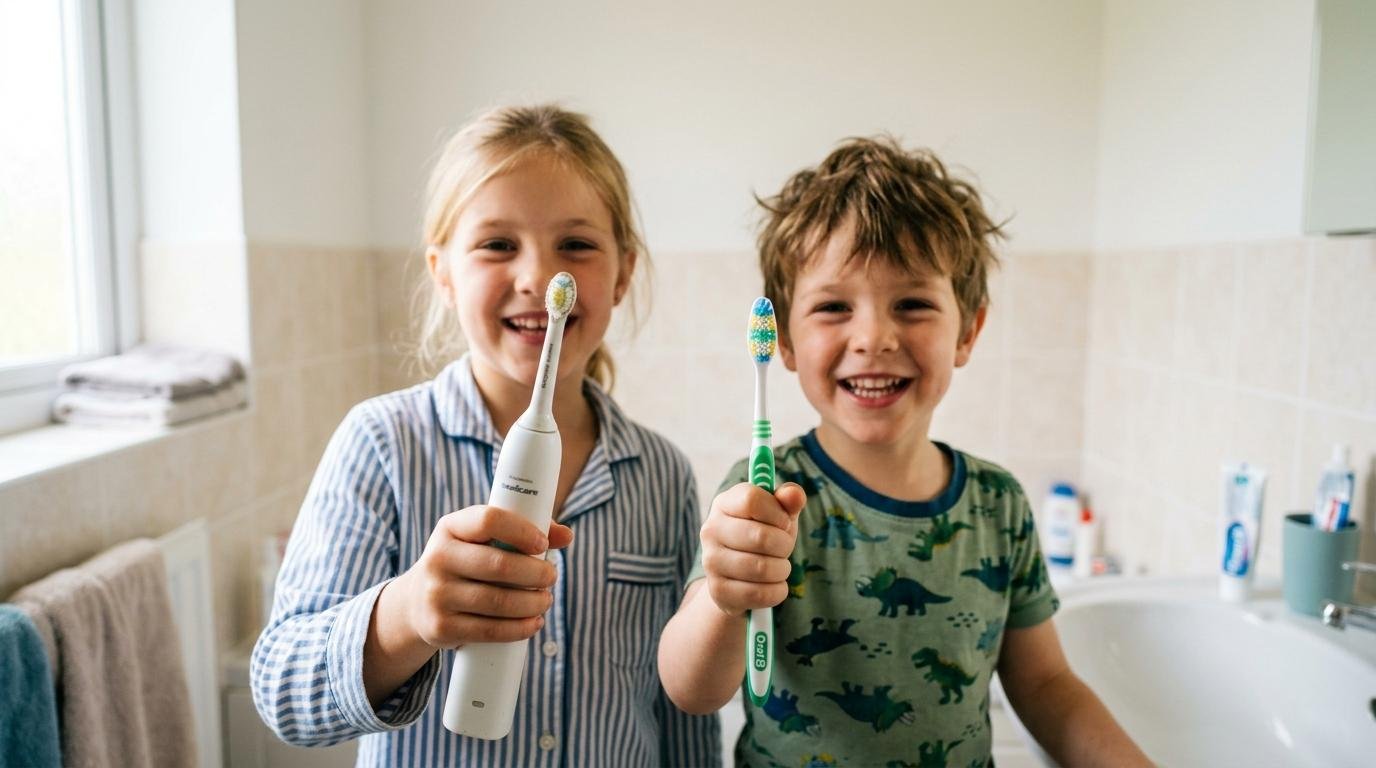
Stand in the toothbrush aisle for a minute and you will see the problem. On one side, manual brushes for a couple of dollars, in every color and cartoon character a child could want. On the other, electric brushes for kids that spin, buzz, light up, play music, and cost as much as a pair of shoes. Somewhere between them, a parent is wondering whether the expensive one is worth it, or whether it is one more gadget that will end up in a drawer.
Parents ask us this at nearly every checkup, so here is the straight answer, and the honest part that the packaging leaves out.
The Straight Answer
A manual toothbrush used well for two minutes, twice a day, cleans a child's teeth. An electric toothbrush used well for two minutes, twice a day, cleans them a little better. The research on this is fairly consistent: powered brushes, especially the kind with a small round head that oscillates and rotates, remove somewhat more plaque and lead to somewhat healthier gums than manual brushes over a few months of use. The difference is real but modest.
Here is the part that matters more. The gap between a manual brush used well and a manual brush used badly is far bigger than the gap between manual and electric. Most kids brush for about forty-five seconds, skip the back molars, and never touch the inside surfaces of the lower front teeth. No motor fixes that by itself. What fixes it is time, technique, and a parent involved.
So the real question is not "which brush cleans better in a lab." It is "which brush will my child actually use correctly, twice a day, for two full minutes." For a lot of kids, the honest answer is the electric one, and not because of the motor.
Why Electric Brushes Often Win in Real Life
- The built-in timer. Most kids' electric brushes run for two minutes and pulse every thirty seconds to say "move to the next section." That single feature does more for a child's brushing than anything else on the box. Two minutes stops being a negotiation.
- Less technique required. The brush head does the small scrubbing motion. Your child only has to hold it against each tooth and move slowly along. For a six-year-old whose wrist control is still developing, that is a real advantage.
- Pressure sensors. Many models light up or stop when a child scrubs too hard. Scrubbing hard is the most common thing we see damaging gums in older kids and teens, and it starts young.
- Kids like them. A brush that buzzes and has a favorite character on it gets used. Novelty wears off, but a habit built during the novelty tends to stay.
- Help for kids who need it. Children in braces, children with sensory differences who tolerate vibration well, and children with limited fine motor skills often do noticeably better with a powered brush.
Where a Manual Brush Is the Right Call
- Babies and toddlers. Under three, a small soft manual brush in a parent's hand is the right tool. The vibration and noise of an electric brush can be too much, and the head of most powered brushes is too big for a tiny mouth.
- A child who hates the buzz. Some kids simply will not tolerate the vibration. A brush that causes a fight every night is the wrong brush, no matter how good the motor is.
- Travel and school. A manual brush in the backpack for after lunch, or in the overnight bag, keeps the habit going without the charger.
- Budget. Two good manual brushes replaced every three months cost less than one set of replacement heads. If the money is a stretch, a manual brush plus a two-minute timer on your phone gets most of the benefit.
What Age Makes Sense
There is no rule that says a child must switch at a certain birthday, but here is what we tell parents:
- Birth to about three: soft manual brush, parent brushing. Rice-grain smear of fluoride toothpaste from the first tooth.
- About three to six: either brush works. If you try a powered brush, choose one labeled for kids with a small head and gentle setting, and let your child hold it while you guide the hand. Pea-sized toothpaste from age three.
- Six and up: this is when a kids' electric brush earns its keep. Permanent molars are coming in with deep grooves, the child is brushing more on their own, and the timer and sensor do the coaching you cannot do from the doorway.
Whichever brush you choose, keep brushing for your child, or right after them, until they can tie their own shoes reliably. That is usually around seven or eight. Before that, they do not have the coordination to reach every surface, and the back molars pay the price. This is true with an electric brush too. The motor does not know where the child forgot to go.
Features Worth Paying For, and Ones That Are Not
Worth it:
- A two-minute timer with thirty-second pacing. Non-negotiable.
- A small, soft brush head sized for a child's mouth. Adult heads do not fit around a child's back teeth.
- A pressure sensor, especially for a child who scrubs.
- Replacement heads that are easy to find. A brush you cannot get heads for becomes a paperweight.
- A rechargeable base over disposable batteries, if the budget allows. Battery-powered brushes weaken as the battery drains and end up in the trash.
Not worth much:
- Five cleaning modes. Kids use one.
- Bluetooth and apps. Some kids love them for a week. If the app gets your child to two minutes, fine, but it is not what you are paying for.
- "Whitening" heads or modes for children. Children's teeth do not need whitening, and harder bristles are not better.
Sonic vs. Oscillating: Does It Matter?
Powered brushes come in two main types. Oscillating-rotating brushes have a small round head that turns back and forth. Sonic brushes have a head shaped more like a manual brush that vibrates very fast. Both clean well. The research gives a slight edge to the oscillating-rotating style for plaque removal, but the difference between the two is smaller than the difference between using either one well and using it badly. Pick the one your child will hold, and the one you can find heads for.
How to Use Each One Correctly
With an electric brush: put the head on the tooth before you turn it on, or toothpaste ends up on the mirror. Hold the bristles at the gumline, angled slightly toward the gum. Do not scrub. Rest the head on each tooth for a couple of seconds, then slide to the next one. Outside surfaces, inside surfaces, chewing surfaces, top and bottom. Let the timer pace it.
With a manual brush: same angle at the gumline, and small gentle circles, not long side-to-side strokes. Two minutes by a timer, a song, or a sand timer on the sink. Two minutes always feels longer than a child thinks it should. The inside of the lower front teeth and the back of the last molars are the spots that get skipped, so check them.
Either way, brush after breakfast and right before bed, spit, and do not rinse with water afterward. Leaving the fluoride toothpaste on the teeth is what lets it work. Our guide to tooth-brushing tips for kids goes deeper on the routine, and our guide on whether fluoride is safe for kids covers the toothpaste question.
Three Questions We Hear Every Week
"My child has braces. Electric or manual?" Electric, in most cases. Brackets and wires trap food, and a small round oscillating head gets around them better than a flat manual brush. Add a floss threader or a water flosser and the orthodontist will notice the difference.
"Can my toddler share the electric brush handle with a sibling?" The handle, yes, with separate heads that are clearly marked. The heads, never. Brushes carry germs, and strep and colds move between siblings on shared bristles.
"Is a battery-powered brush from the checkout aisle good enough?" It is better than a manual brush used for forty-five seconds, and it is a fine way to find out whether your child tolerates the buzz before you spend more. Just replace it when it weakens, because a slow brush cleans like a manual one without the technique.
Replace It on Time
Manual brushes and electric heads both need replacing every three months, and sooner if the bristles splay out. Flat, bent bristles do not clean, and a child who chews the brush (most do) will wear one out faster. Replace the brush after a bout of strep throat as well. If you cannot remember when you last changed it, it is time.
What Matters More Than the Brush
If we could put one thing on the box, it would be this: the brush is the least important part of brushing. Two minutes, twice a day, with fluoride toothpaste, with a parent involved until age seven or eight, and flossing once the back teeth touch, is what keeps cavities away. A four-dollar manual brush with all of that beats a sixty-dollar electric brush without it every time.
Bring whatever brush your child uses to their next checkup. We will watch them brush, show you both the spots they miss, and tell you honestly whether an upgrade would help your child or just cost you money. We have four locations across North Carolina in Greensboro, Winston-Salem, Raleigh, and Monroe, and this is one of our favorite questions to answer.