
If your child's dentist mentioned sealants at the last appointment and you nodded along while quietly wondering whether they're actually necessary, this article is for you. Sealants are one of the most studied and most effective preventive treatments in pediatric dentistry, and they're also one of the least clearly explained to parents. By the time you finish reading, you'll know exactly what they are, when they help, when they don't, and whether they make sense for your child.
After years of placing sealants on children's teeth across our four North Carolina locations, our team at Pediatric Dentistry by Dr. Jeffries has had this conversation with thousands of parents. The same questions come up every time. We're going to answer them straight.
What Sealants Actually Are
A dental sealant is a thin layer of safe, tooth-colored plastic resin painted onto the chewing surfaces of your child's back teeth. The dentist or hygienist cleans the tooth, paints on the liquid sealant, and uses a small light to harden it in place. The whole process takes a few minutes per tooth and doesn't involve any drilling, numbing, or pain.
The hardened sealant fills in the deep grooves and pits on top of molars (the technical name is "occlusal pits and fissures") that toothbrush bristles cannot fully clean. Once those grooves are sealed, food and bacteria cannot get trapped in them, and a major source of childhood cavities is taken off the table.
That's the short version. Now let's look at why those specific teeth get this specific treatment.
Why Back Teeth Get So Many Cavities
Run your tongue along the chewing surface of your own back teeth right now. Feel the grooves and the small valleys? Those are the natural shape of molar surfaces, designed to grind food. They're also the perfect hiding place for sticky food particles.
The bristles on a toothbrush are wider than those grooves. No matter how diligently a child brushes, the deepest pits in their molars never get fully cleaned. Bacteria settle in, feed on the trapped food, and produce acid. Over time, that acid wears through the enamel and causes a cavity.
This is why most childhood cavities show up on the back teeth, not the front. It is not because kids brush their front teeth better. It is because their front teeth are smoother and easier to clean by design. Their molars are working against them.
Sealants change the geometry. They turn a grooved, hard-to-clean surface into a smooth one.
The Evidence
The Centers for Disease Control and Prevention has published extensively on sealants over the past two decades. The data is clear and consistent.
According to the CDC, school-age children without sealants have almost three times more cavities in their first molars than children with sealants. Sealants reduce the risk of decay by up to 80 percent in the back teeth where they are applied. They protect against new cavities for up to four years and continue to reduce risk for nine years and beyond.
For comparison, fluoride toothpaste, fluoride water, and good brushing habits are excellent preventive tools, but none of them physically block food from settling into the deep grooves where most cavities form. Sealants do something the other tools cannot.
If your child has a high cavity history, sealants matter more. If they have low cavity history, sealants still help. The math works out either way.
When Sealants Get Applied
The most common timing is right after the permanent first molars come in, around age six. These teeth come in behind the baby teeth and most parents do not even notice them erupting because they don't replace anything that fell out.
The second wave is around age twelve, when the second molars come in behind the first ones.
Some children with deep grooves on their baby molars get sealants on those too, especially if they have a history of cavities. Baby teeth still matter, and sealing them protects against painful cavities and the need for fillings before the permanent teeth even arrive.
We can usually tell during a regular checkup whether your child's molar surfaces are good candidates. Some children naturally have shallow, smooth grooves that don't need sealing. Others have deep, narrow ones that almost guarantee cavity trouble without intervention. Each child gets evaluated individually.
Are Sealants Safe? The BPA Question
Some parents have heard concerns about BPA in dental sealants. This is the most common safety question we get, and we want to answer it directly.
Older sealant formulations did contain trace amounts of BPA derivatives. Modern dental sealants used in pediatric practices today have been reformulated. The American Academy of Pediatric Dentistry, after reviewing the research, has concluded that the BPA exposure from sealants is far below what a child encounters from many everyday sources, and that the cavity-prevention benefits far outweigh any theoretical risk.
If you have specific questions about which sealant brand we use at our office, just ask at the appointment. Our team will tell you exactly what is going on your child's tooth and why we chose it.
How Long They Last
A well-placed sealant typically lasts five to ten years. Some last longer. They don't last forever, and they can chip or wear down over time, especially in children who grind their teeth or chew aggressively on hard foods.
This is why we check sealants at every regular cleaning appointment. If one has worn down or come off, we can usually replace it that same visit. The reapplication is fast and just as painless as the first time.
The good news: by the time most sealants are wearing out, your child has reached an age where their oral hygiene habits are stronger and the cavity risk on those teeth has dropped naturally.
Cost and Insurance
Most dental insurance plans cover sealants for children, often at 100 percent for ages six through fifteen. The American Dental Association considers sealants a standard preventive service, not a cosmetic one, and most plans treat them that way too.
If you're uninsured or paying out of pocket, sealants are still one of the most cost-effective preventive treatments in dentistry. The cost of sealing a molar is a small fraction of the cost of filling a cavity in that same tooth later. Our front desk staff can give you exact pricing during your visit.
What the Appointment Looks Like
Parents often ask what to expect, especially if their child has any dental anxiety. The visit goes like this.
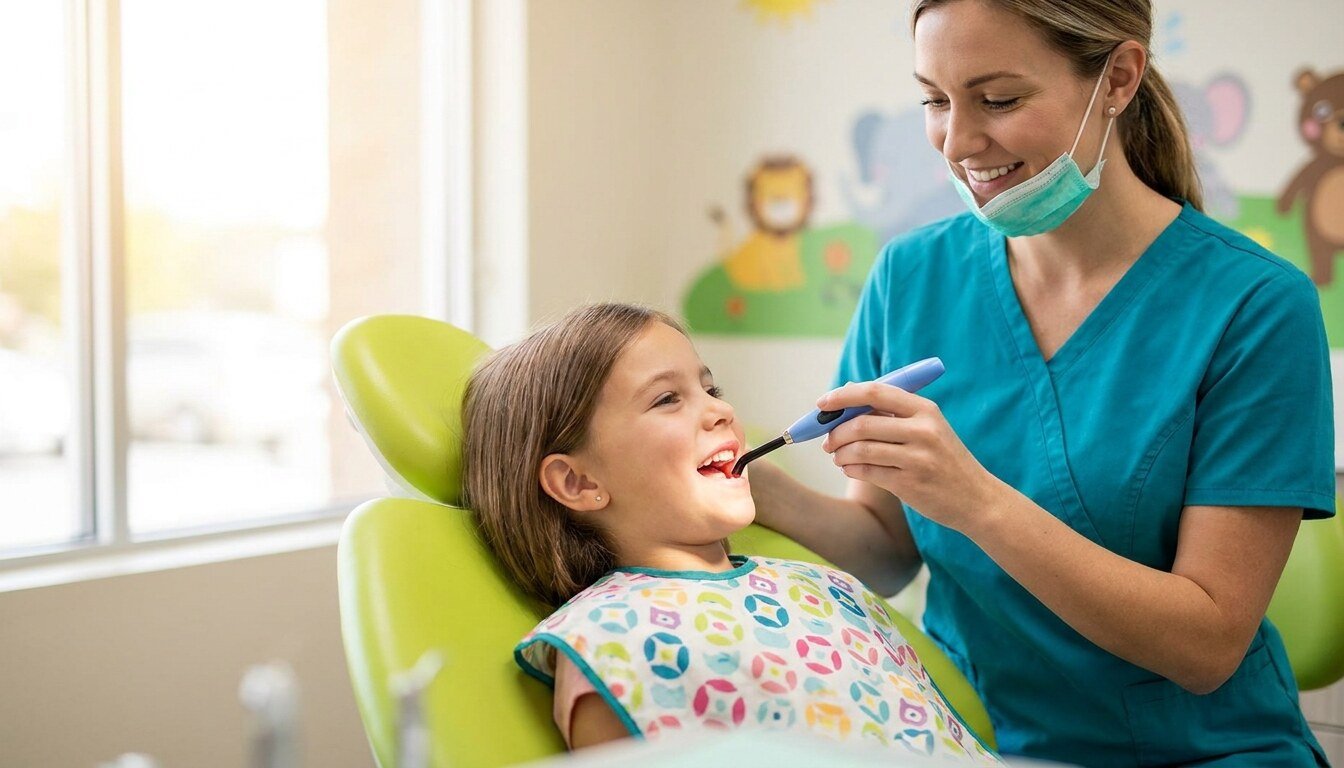
Your child sits in the chair. The hygienist cleans the molars getting sealed. They dry the teeth and apply a slightly acidic gel that helps the sealant bond, then rinse it off. They paint on the liquid sealant, which feels and tastes a bit like nail polish to most kids. A small handheld light cures the sealant in seconds. They check the bite, smooth any rough spots, and your child is done.
Total time: usually under ten minutes for a few teeth. No needles. No drilling. No numbing. Most kids are surprised at how fast it is.
If your child is nervous about dental visits in general, talk to us about it before the appointment. Our office is built for kids who feel cautious about the dentist, and we have experience walking children through this kind of treatment in a way that builds trust instead of fear. For children with significant dental anxiety, we also offer sedation options when appropriate, although sealants almost never require it.
Common Misconceptions Worth Clearing Up
"My child brushes well, so they don't need sealants."
Brushing technique is great. It just doesn't reach into the deepest grooves of molar surfaces. Sealants do work brushing cannot do.
"Sealants are only for kids with cavity problems."
Sealants prevent cavities. Waiting until a child has cavities to use them defeats the purpose. They make the most sense before any decay has started.
"They feel weird in the mouth."
For about a day, your child might notice the new sealed surface. After that the sealant feels exactly like the original tooth.
"They block teeth from being cleaned."
Sealants only cover the top chewing surface. The sides, where flossing happens, are completely unaffected.
"They're permanent."
They are durable but not permanent. We check them regularly and replace any that wear down.
When Sealants Are the Right Call
For most children with permanent molars in their mouths, sealants are a small, fast, painless step that significantly reduces cavity risk for years. They are particularly worth the conversation if your child:
- Has deep grooves on their molars (visible on regular exam)
- Has had cavities before, especially in their baby molars
- Struggles with brushing technique or compliance
- Drinks juice or eats sticky snacks regularly
- Has any developmental challenges that affect their oral hygiene routine
- Just got their first permanent molars (around age six)
If you're not sure whether sealants make sense for your child, the next regular checkup is the right time to ask. We will show you exactly which teeth would benefit, walk through the process, and answer every question before scheduling anything. No pressure, just a clear picture of what your child's molars actually look like and what would help them most.
At Pediatric Dentistry by Dr. Jeffries, we treat sealants the way we treat every preventive service: as one part of the larger picture of helping your child grow up with healthy teeth, low anxiety about dental care, and good habits for life. If you have questions before your next visit, give us a call at any of our four locations across North Carolina. We are glad to talk through what makes sense for your family.