
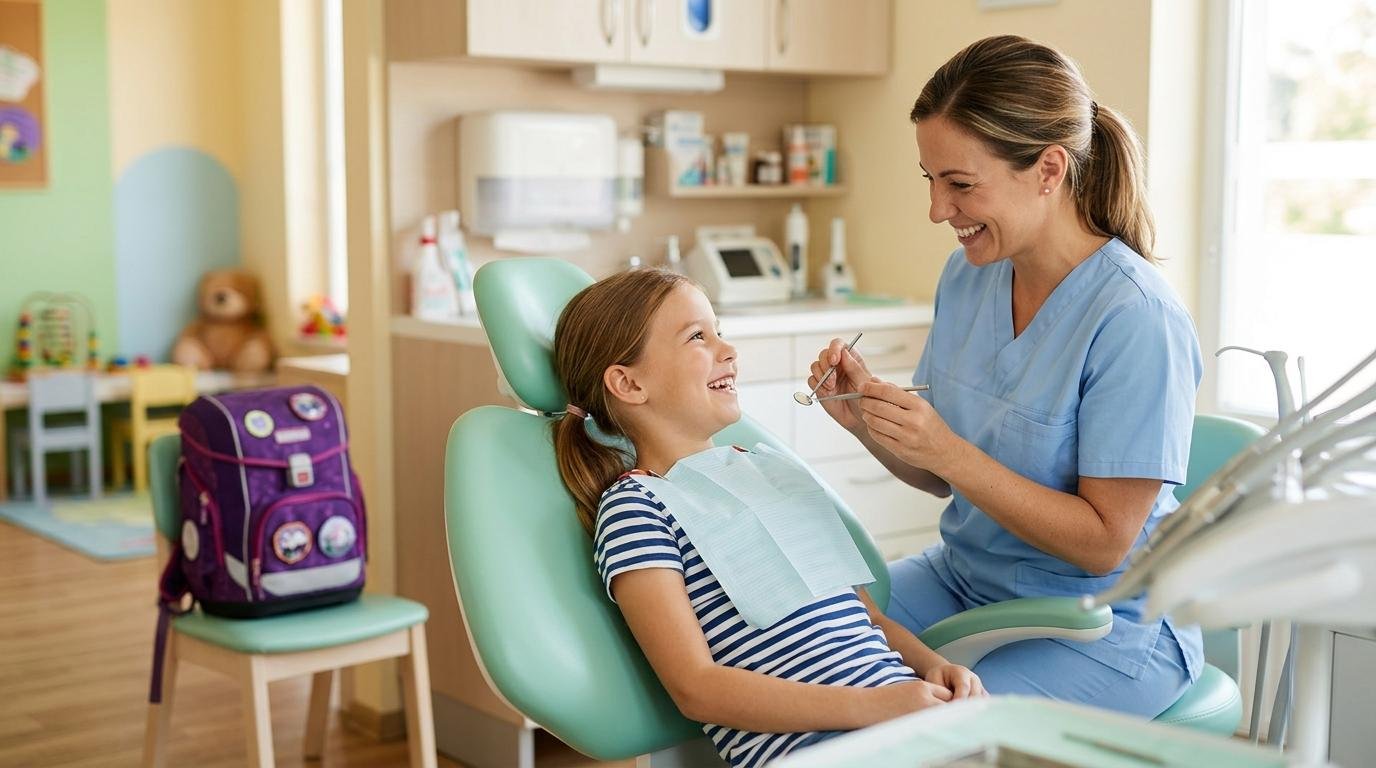
The back-to-school list is long. Shoes that fit, a backpack that survived last year, supplies, physicals, haircuts, and somewhere near the bottom, in smaller handwriting, the dentist. It is the item most likely to get bumped to "we'll do it once things settle down," and things almost never settle down.
Here is the case for moving it up the list. August is the single best month of the year to bring your child in, and not because of the calendar on our wall. It is because a small problem found in August is a quick visit, while the same problem found in November is a phone call from the school nurse, a child in pain, and a day of work you did not plan to miss. Our team at Pediatric Dentistry by Dr. Jeffries sees this pattern every single fall, and it is almost always preventable.
Why August Beats Every Other Month
Summer is hard on teeth, and the damage does not show up right away. Schedules loosen, bedtimes slide, popsicles and sports drinks and snow cones become daily instead of occasional, and brushing quietly drops from twice a day to once, or to a fast pass at the sink on the way to bed. None of that causes a cavity overnight. It causes one over eight or ten weeks, which lands right about now.
An August visit catches that early decay while it is still small, still painless, and still a simple fix. Wait a few months and the same spot can reach the nerve, and now you are talking about a bigger appointment, a more anxious child, and a much longer chair time.
The practical reasons matter too. Once school starts, every appointment competes with class time, sports practice, and homework. Pulling your child out at 1:00 on a Tuesday in October means missed instruction and a scramble for the rest of the day. In August you can take a mid-morning slot without any of that. Our schedule also fills fast in the last two weeks before school starts, so families who call early get the times they actually want instead of whatever is left.
There is a quiet money reason as well. Dental benefits usually run on a calendar year, and unused coverage does not roll over. A checkup and cleaning now uses benefits you have already paid for, and if the exam turns up something that needs treatment, you have four full months to get it handled before the year resets.
What Actually Happens at the Visit
If it has been a while, or if this is your child's first checkup with us, it helps to know what the appointment looks like. There are no surprises in it, and knowing the steps makes it easier to explain to a nervous kid.
- A gentle cleaning. We remove plaque and hardened tartar that brushing at home cannot reach, then polish the teeth. This is the part most kids like, because their teeth feel smooth afterward.
- A full exam. We check every tooth for decay, look at the gums, and watch how the bite is coming together as the jaw grows.
- X-rays when they are needed. Not at every visit and not for every child. Cavities between teeth are invisible to the eye, and X-rays are how we find them before they get big.
- Fluoride treatment. A quick varnish that strengthens the enamel and helps reverse the earliest stages of decay. It takes about a minute.
- A look at what is coming. Loose baby teeth, permanent molars pushing in, crowding, spacing, and whether an orthodontic consult is worth thinking about yet.
- Time to ask questions. Thumb habits, grinding at night, a chipped tooth from summer, a tooth that "feels funny." Bring all of it.
For most children the whole thing takes about 45 minutes, and a lot of that is conversation.
The School Forms Nobody Warns You About
Some schools, preschools, and Head Start programs ask for a dental form signed by a dentist, and parents often find out about it the week it is due. If your child's school requires one, bring the paperwork to the appointment and we will complete it while you are here. That saves a second trip and a frantic email later.
It is worth asking the front office in early August rather than waiting for a notice to come home in a folder. Requirements change from district to district and from grade to grade.
Rebuilding the Routine Before the Alarm Clock Does
The first week of school is a rough time to reintroduce a habit. Mornings are already tight, evenings are full of homework and practice, and everyone is tired. If brushing slipped over the summer, start rebuilding it two weeks before school begins, while there is still slack in the day.
A few things that help:
- Move bedtime earlier in small steps. Fifteen minutes every few nights is easier than one painful jump, and a child who is not exhausted brushes better.
- Anchor brushing to something fixed. Right after breakfast and right before pajamas beats "sometime before bed," which quietly turns into never.
- Two minutes, twice a day. Use a song, a timer, or a two-minute video. Most kids brush for about 45 seconds and believe it was much longer.
- Restock now. A new toothbrush every three months, and sooner if the bristles are bent. Flat bristles do not clean.
- Put flossing back in. Once the back teeth touch each other, a brush cannot reach between them. Floss picks work fine and are far easier for small hands.
Lunch matters too. Sticky fruit snacks, gummies, and juice pouches sit on the teeth all afternoon with no chance to brush them away. Water in the bottle instead of juice is one of the highest-value swaps a parent can make, and our guide on the best and worst snacks for kids' teeth breaks down the rest of the lunchbox.
The Cavity You Cannot See Yet
This is the part that surprises parents most. A cavity does not hurt at first. By the time a child says a tooth hurts, the decay has usually reached the inner layers, and what would have been a small filling is now a bigger procedure.
Dental problems are also one of the more common reasons kids miss school, and pain is a terrible study partner. A child sitting in class with a throbbing molar is not learning much. Catching that spot in August, when it is still a shadow on an X-ray, protects both the tooth and the school year.
Watch for these between visits: a tooth that reacts to cold or sweets, a white or brown spot on a tooth surface, food that keeps getting stuck in the same place, bleeding gums during brushing, or persistent bad breath. Any one of them is a reason to call rather than wait for the next scheduled cleaning.
If Your Child Is Nervous About Coming In
Plenty of kids are, and August is a better time to work on it than an emergency visit in the middle of a school night. A routine cleaning with nothing wrong is the ideal appointment for a nervous child, because nothing uncomfortable happens and the whole thing ends with a smooth-teeth feeling and a high five.
Keep your own language neutral at home. Words like "shot," "drill," and "it won't hurt" plant ideas that were not there before. Let us do the explaining in kid-sized terms, which is something our team does all day long. Our guide on helping a child who is afraid of the dentist covers the approach in more detail, including what to say the morning of.
Sports, Braces, and Other August Add-Ons
Fall sports start before school does in a lot of districts, so if your child is heading into football, soccer, basketball, wrestling, or anything with contact, this visit is the right time to sort out a mouthguard. A custom guard fits better and gets worn more, and a guard that stays in is the only one that protects anything. Our guide on mouthguards for youth sports compares the options honestly.
August is also a good moment to ask about sealants for newly erupted permanent molars, since those deep grooves are where most childhood cavities start. And if your child is around age seven, it is a reasonable time to ask whether an orthodontic evaluation makes sense yet.
Your Back-to-School Dental Checklist
- Book the checkup and cleaning for both children, ideally back to back.
- Ask the school whether a signed dental form is required, and bring it with you.
- Replace toothbrushes and restock floss picks and toothpaste.
- Start shifting bedtime earlier two weeks out.
- Rebuild the two-minute, twice-a-day habit before the first bell.
- Ask about sealants, and about a mouthguard if a fall sport is starting.
- Pack water instead of juice, and keep sticky snacks for home where teeth can be brushed after.
When to See Us
If it has been six months or more since your child's last visit, now is the time. We have four locations across North Carolina in Greensboro, Winston-Salem, Raleigh, and Monroe, and we can usually get siblings seen in the same block so you make one trip instead of two.
Summer habits are worth a look before they harden into the school year, and our guide on summer dental care for kids covers what tends to slip between June and August. Bring your questions with you. There is no such thing as a small one when it comes to your child's teeth.